Your Cycle Is More Than Just Your Period
Most of us were taught that a menstrual cycle is simply the time between periods. But your cycle is actually a complex, beautifully orchestrated hormonal process that influences almost every aspect of how you feel ? your energy levels, your mood, your skin, your sleep, your libido, and even your cognitive strengths.
Understanding your cycle is one of the most empowering things you can do for your health. When you know what is happening hormonally at each phase, you can start to work with your body rather than against it.
The Four Phases of Your Menstrual Cycle
Phase 1: Menstruation (Days 1-5)
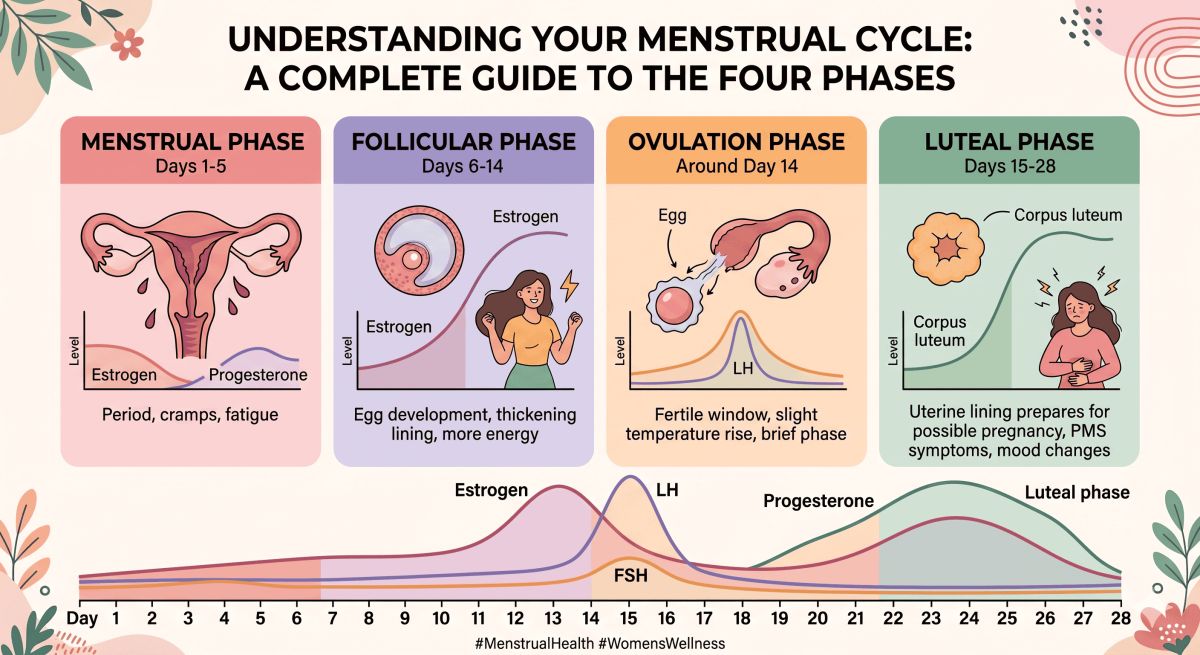
Your cycle officially begins on the first day of your period. During menstruation, the uterine lining sheds because no pregnancy occurred. Both estrogen and progesterone are at their lowest point. Prostaglandins cause the uterus to contract to expel the lining, which is why many women experience cramps.
What you might feel: Fatigue, lower energy, inward focus, cramps, and a desire to slow down. This is your body asking for rest, and it is worth listening.
What helps: Iron-rich foods (lentils, spinach, red meat), anti-inflammatory foods (ginger, turmeric), heat therapy for cramps, and gentle movement like walking or yoga.
Phase 2: Follicular Phase (Days 1-13)
The follicular phase overlaps with menstruation and continues until ovulation. The pituitary gland releases follicle-stimulating hormone (FSH), which stimulates follicles in the ovaries to grow. Rising estrogen boosts serotonin, improves insulin sensitivity, and increases collagen production ? which is why your skin often looks its best in this phase.
What you might feel: Increasing energy, optimism, sociability, mental clarity, and motivation. Many women feel their most productive and creative in the late follicular phase.
What helps: This is a great time for starting new projects, social activities, high-intensity exercise, and foods that support estrogen metabolism like cruciferous vegetables.
Phase 3: Ovulation (Around Day 14)
Ovulation is the main event of your cycle ? the moment a mature egg is released from the dominant follicle. It is triggered by a surge in luteinizing hormone (LH). The egg is only viable for 12-24 hours after release, but sperm can survive for up to 5 days, making your fertile window approximately 5-6 days.
What you might feel: Peak energy, confidence, heightened libido, and a desire to connect with others. Many women feel their most outgoing and attractive around ovulation ? this is biology at work.
What helps: Zinc-rich foods (pumpkin seeds, chickpeas) support egg quality. Antioxidants (berries, leafy greens) protect the egg from oxidative stress.
Phase 4: Luteal Phase (Days 15-28)
After ovulation, the ruptured follicle transforms into the corpus luteum, which produces progesterone. If fertilisation does not occur, the corpus luteum breaks down, causing progesterone and estrogen to drop sharply ? triggering menstruation and beginning the cycle again.
The luteal phase is when PMS symptoms typically occur. The drop in serotonin caused by falling estrogen can affect mood. Progesterone can cause bloating, breast tenderness, and fatigue.
What you might feel: Slower energy, increased need for rest, heightened sensitivity, food cravings, bloating, and mood changes.
What helps: Complex carbohydrates stabilise blood sugar and support serotonin. Magnesium reduces cramps and mood symptoms. Reducing caffeine, alcohol, and sugar can significantly improve luteal phase symptoms.
How Long Should a Normal Cycle Be?
A normal menstrual cycle can range from 21 to 35 days, with the average being around 28 days. Your period itself typically lasts 2-7 days. Cycles shorter than 21 days or longer than 35 days, or periods that are very heavy or very painful, are worth discussing with a healthcare provider.
Why Tracking Your Cycle Matters
Tracking your cycle is not just about knowing when your period is coming. It is about building a detailed picture of your hormonal health over time. Patterns in your data ? changes in cycle length, flow, symptoms, mood, and temperature ? can reveal important information about your health and help you and your doctor identify any issues early.
Start simple: note the first day of your period each month. Then gradually add more data ? flow intensity, mood, symptoms, energy levels. Over 3-6 months, you will start to see your personal patterns emerge, and that knowledge is genuinely powerful.