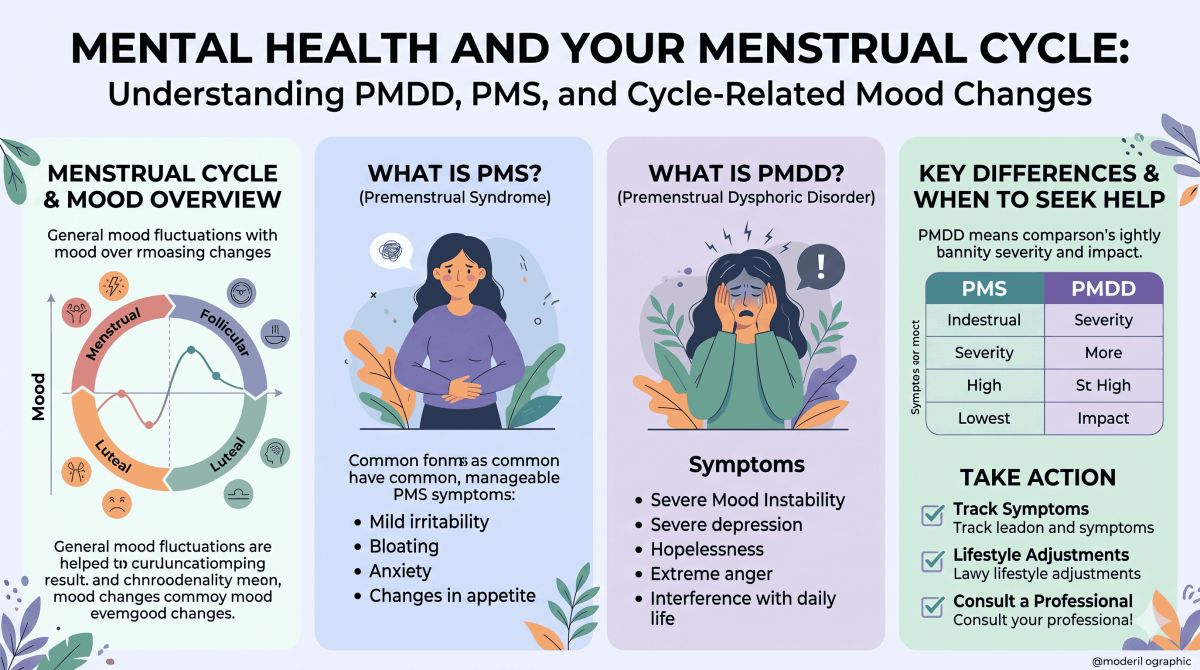
Why Your Mood Changes Throughout Your Cycle
If you have ever noticed that you feel completely different at different points in your cycle ? more confident and social around ovulation, more anxious and withdrawn before your period ? you are not imagining it. These shifts are real, they are hormonal, and they affect the vast majority of women.
The key hormones involved are estrogen and progesterone, both of which have profound effects on the brain. Estrogen boosts serotonin (the feel-good neurotransmitter), dopamine (motivation and reward), and GABA (the calming neurotransmitter). When estrogen is high ? in the follicular phase and around ovulation ? most women feel their best.
Progesterone, which dominates the luteal phase, has a more complex effect. It can have a calming, sedative quality for some women, but in others ? particularly those sensitive to its metabolite allopregnanolone ? it can trigger anxiety, irritability, and low mood. When both estrogen and progesterone drop sharply in the late luteal phase, serotonin drops with them, which is why the days before a period are often the most emotionally challenging.
What Is PMS?
Premenstrual syndrome (PMS) is a collection of physical and emotional symptoms that occur in the luteal phase (typically the 1-2 weeks before your period) and resolve within a few days of menstruation starting. PMS affects up to 75% of women to some degree.
Common PMS symptoms include mood swings, irritability, anxiety, sadness, fatigue, bloating, breast tenderness, headaches, food cravings, and difficulty concentrating. By definition, PMS symptoms must be severe enough to interfere with daily life ? not just mild discomfort.
What Is PMDD?
Premenstrual dysphoric disorder (PMDD) is a severe form of PMS that affects approximately 3-8% of women. It is classified as a depressive disorder in the DSM-5 (the diagnostic manual used by psychiatrists), which reflects the seriousness of its impact on mental health and daily functioning.
PMDD is characterised by severe mood symptoms in the luteal phase ? including marked depression, hopelessness, intense anxiety, anger, irritability, and in some cases, suicidal thoughts ? that resolve completely within a few days of menstruation starting. The cyclical, predictable nature of symptoms is the defining feature that distinguishes PMDD from other mood disorders.
PMDD is not caused by "too much" progesterone or estrogen ? hormone levels in women with PMDD are typically normal. Research suggests that women with PMDD have an abnormal sensitivity to normal hormonal fluctuations, particularly to the rise and fall of allopregnanolone (a progesterone metabolite that affects GABA receptors in the brain).
How to Track Cycle-Related Mood Changes
The most important step in understanding and managing cycle-related mood changes is tracking. Use this app to log your mood, energy, and symptoms daily alongside your cycle data. After 2-3 months, patterns will emerge that can help you and your doctor understand what is happening.
For a PMDD diagnosis, your doctor will typically ask you to track symptoms prospectively (in real time, not retrospectively) for at least two cycles. The key diagnostic criteria are: symptoms occur only in the luteal phase, symptoms resolve within a few days of menstruation, and symptoms significantly impair daily functioning.
What Actually Helps
Lifestyle Interventions
- Regular exercise: Aerobic exercise is one of the most evidence-based interventions for PMS and PMDD. It boosts endorphins, serotonin, and BDNF (brain-derived neurotrophic factor). Even 30 minutes of brisk walking 5 days a week makes a measurable difference.
- Sleep: Poor sleep dramatically worsens mood symptoms. Prioritising 7-9 hours of sleep, particularly in the luteal phase, is one of the most impactful things you can do.
- Diet: Reducing sugar, refined carbohydrates, caffeine, and alcohol in the luteal phase can significantly reduce mood symptoms. Complex carbohydrates support serotonin production. Magnesium (from food or supplements) has strong evidence for reducing PMS mood symptoms.
- Stress management: Chronic stress worsens hormonal imbalances and amplifies luteal phase symptoms. Yoga, meditation, breathwork, and therapy are all evidence-based approaches.
Supplements with Evidence
- Magnesium glycinate (300-400mg daily): Strong evidence for reducing PMS mood symptoms, anxiety, and bloating.
- Vitamin B6 (50-100mg daily): Supports serotonin and dopamine production. Multiple studies show benefit for PMS mood symptoms.
- Calcium (1200mg daily): Several randomised controlled trials show calcium supplementation reduces PMS symptoms including mood changes and physical symptoms.
- Vitex (Chasteberry): Some evidence for reducing PMS symptoms, particularly breast tenderness and mood changes. Takes 3 months to see effects.
Medical Treatments for PMDD
- SSRIs (selective serotonin reuptake inhibitors): The first-line medical treatment for PMDD. Uniquely, SSRIs for PMDD can be taken only in the luteal phase (intermittent dosing) rather than continuously, which many women prefer. They work within days rather than weeks for PMDD, unlike their use in depression.
- Combined oral contraceptive pill: Particularly the pill containing drospirenone (e.g., Yaz/Yasmin) has evidence for PMDD. By suppressing ovulation, it eliminates the hormonal fluctuations that trigger symptoms.
- GnRH analogues: For severe, treatment-resistant PMDD, these medications suppress ovarian function entirely. They are highly effective but have significant side effects and are typically used short-term.
You Are Not Alone
Cycle-related mood changes ? whether mild PMS or severe PMDD ? are real, they are physiological, and they are not a character flaw or a sign of weakness. The fact that symptoms are cyclical and predictable is actually empowering: once you understand your pattern, you can plan around it, prepare for it, and treat it effectively.
If your mood symptoms are significantly affecting your quality of life, please speak to a doctor. PMDD in particular is a serious condition that deserves proper medical attention. You do not have to just cope.